
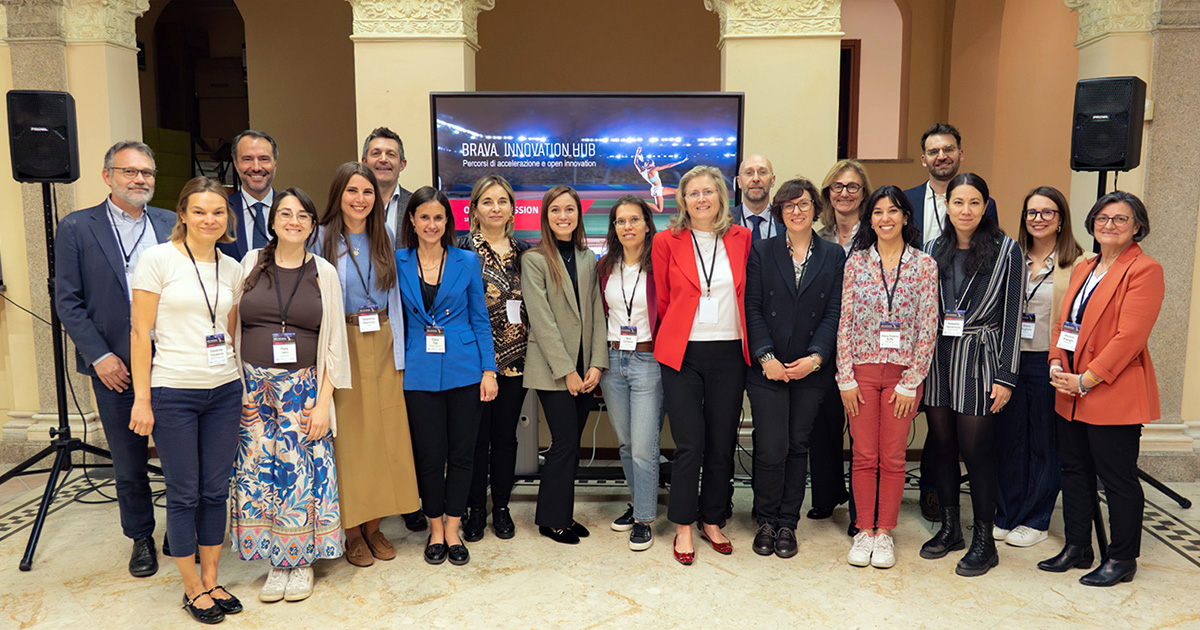
New RNA therapies designed to directly target cardiovascular diseases, systems capable of monitoring dialysis in real time to make it safer, advanced technologies to improve satellite reliability, applied quantum computing to solve complex problems. These are just a few of the 10 innovative projects developed by 10 women-led companies that will play an active role in the 12-week advanced training program organized by Brava Innovation Hub.
The acceleration program, promoted by the Italian Ministry of Enterprise and Made in Italy (MIMIT) and managed by Invitalia, is dedicated to start-ups, micro and small businesses led by women, aiming to make the market entry of the most innovative business ideas faster and more effective.
The ten women-led entrepreneurial teams, capable of combining deep tech with social impact to tackle global challenges, were selected by Invitalia through a national call for proposals to which 137 companies from across Italy responded. The 10 selected companies represent an Italy of tangible innovation, capable of combining advanced research, social impact, and market vision: the chosen projects demonstrate how female leadership is bringing high-impact, useful, tangible, and scalable innovations to market in strategic sectors.
Five of the ten selected start-ups are part of the network of young companies that have been supported, either currently or in recent years, by the Innovative Companies Incubator of Politecnico di Torino (I3P): these are AgerTech, Hematica, Hipparcos, G2Q Computing, and PoliRNA. Two of them, Hipparcos and G2Q Computing, are also part of the community of ESA BIC Turin, the incubation program for space-sector start-ups managed by I3P.
The initiative
Brava Innovation Hub is part of Imprenditoria Femminile (Female Entrepreneurship), a program funded by MIMIT with resources from PNRR - Next Generation EU and managed by Invitalia, which aims to promote an entrepreneurial culture among women and increase their presence in the workforce and the business world, particularly in the fields of science and technology.
This initiative is part of a broader effort by Invitalia to support women’s entrepreneurship, with the aim of promoting women’s talent and fostering an increasingly balanced participation in economic development processes. At the same time, the program helps strengthen Italian entrepreneurship by supporting innovative projects capable of competing in the market and building solid, sustainable growth trajectories.
For three months, the selected companies will work to accelerate the development of their innovative projects at the Rete Hub in Novara, in the Italian region of Piedmont. The training program will be carried out by Tree S.r.l. (Opinno Italy group), Fabrick S.p.A., and SheTech ETS, the companies that won the competitive bidding process organized by Invitalia.
Each company will be able to count on:
- a grant of €40,000;
- over 60 hours of one-on-one mentoring with experts from the business, technology, and finance sectors;
- advanced training in business strategy, finance, marketing, communication, legal matters, and leadership;
- dedicated workspaces, networking opportunities, business matching, and open innovation;
- three key opportunities for discussion and visibility: the opening event, Benchmark Day, and the final Demo Day with investors and partners.
The five start-ups from I3P
AgerTech addresses one of the main limitations of agricultural digitization: the difficulty of collecting data directly in the field. Through AGERIX, a virtual assistant available on WhatsApp, farmers can record activities and information simply by speaking or typing. The system automatically organizes the data, simplifying farm management and administrative tasks. By involving agronomists and cooperatives in its rollout, the solution can scale rapidly. The value of the project lies in making digitalization accessible even to those with limited technological skills.
Hematica is a spin-off of Politecnico di Torino and the University of Florence that has developed a system for real-time monitoring of dialysis, a therapy that is currently difficult to monitor as it is being administered. The technology integrates automated sample collection, biomarker analysis, and predictive models to assess the treatment’s effectiveness while it is underway. This allows for timely intervention and optimizes the use of dialysis filters. The result is a more precise treatment, with potential benefits for patient safety and quality of life.
Hipparcos develops advanced devices (multi-camera star trackers) to precisely determine the orientation of small satellites in space. Unlike traditional solutions, its proprietary technology maintains high performance over time, preventing the degradation that can compromise missions. This is particularly important for satellites that remain operational for many years. This innovation therefore helps increase the reliability of space missions and reduce operational risks in the growing small satellite market.
G2Q Computing develops software that integrates traditional computing and quantum technologies to tackle complex optimization and data analysis problems. These solutions can already be used today on existing computing infrastructure, without the need for dedicated quantum hardware. This enables companies in sectors such as finance, energy, and manufacturing to improve their decision-making and operational processes. The project makes the benefits of quantum computing - which are typically still underutilized - accessible in the short term.
PoliRNA develops innovative nanoparticles to deliver RNA therapies directly to the heart, increasing the precision of treatment. This technology allows the drug to be concentrated in cardiovascular tissue, improving efficacy and reducing side effects on other organs. The results show superior performance compared to current solutions, both in terms of targeting ability and duration of retention in the tissue. The goal is to offer new treatment options for cardiovascular diseases, which are currently one of the leading causes of death worldwide.


