
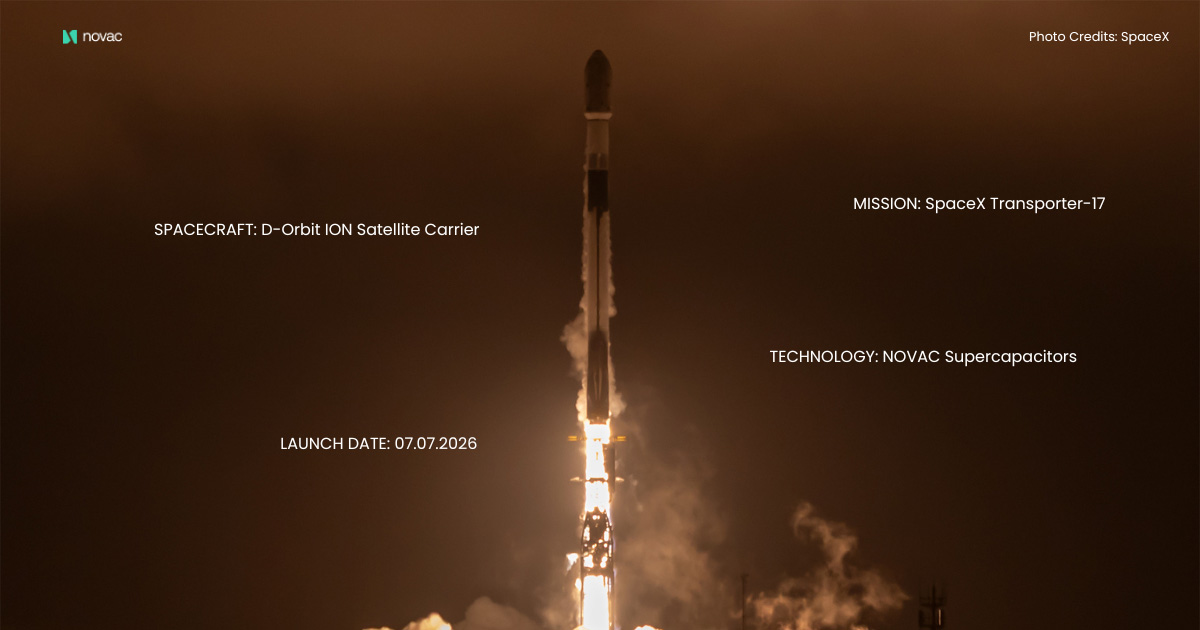
In recent months, the implementation of the project by the Italian start-up Novac – alumni of I3P and of the ESA BIC Turin incubation program – has taken a major leap forward. The supercapacitor technology developed by the young company has been launched into orbit aboard D-Orbit’s ION satellite carrier, as part of SpaceX’s Transporter-17 mission. Today, for the first time, Novac’s supercapacitors have been integrated into the electrical architecture of a commercial satellite.
The launch, which took place in July 2026, marks the start-up's first flight test and represents an important step towards the validation of Novac technology in the space sector. This achievement is the result of years of research, development, design, testing and qualification: throughout this process, the company’s proprietary pouch-type supercapacitors have progressed from the laboratories and production facilities of the young enterprise to an operational space mission.
The start-up's technology
Novac supercapacitors are designed to deliver high power, fast response and reliable energy storage. They target applications where power density, compactness, customisation and reliability are essential requirements, such as those found in the aerospace sector.
Founded in 2020 in Modena, Italy, Novac designs and manufactures supercapacitors with custom cell chemistry, a proprietary management system (Supercapacitor Management System, SCMS) and system-level integration, operating in the mobility and aerospace sectors. In 2025, the company completed a seed funding round of €3.5 million and was named ‘I3P Start-up of the Year’.
For Novac, the mission is a concrete milestone for the approach followed so far and a first step towards its goal of becoming a reference for next-generation high-performance energy storage systems. From the laboratory in Modena to orbit, and this is only the beginning.


