
Nineteen deep-tech start-ups born out of research carried out by Italian universities and public research bodies (EPRs), divided into four sectors of innovation, for a competition that focuses not only on the quality of the technology, but also on the results achieved in the market and the prospects for growth.
Young, innovative start-ups will be the stars of the 2026 edition of the Italian Master Startup Award (IMSA), promoted by PNICube - the national network of universities, academic incubators and regional Start Cup competitions - with the aim of fostering the commercialisation of research, and organised once again this year in collaboration with I3P, the Innovative Companies Incubator of Politecnico di Torino.
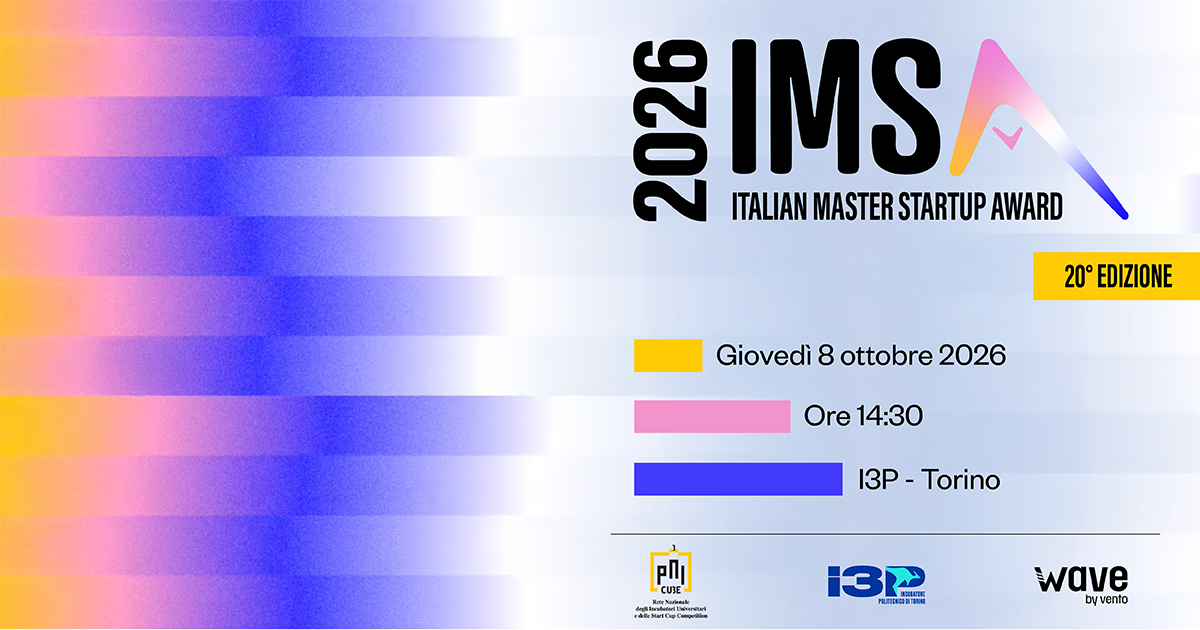
The competition will take place in Turin, Italy, in person in the Agorà Hall at the I3P headquarters, on the afternoon of Thursday 8 October, from 2.30 pm, as a side event of the Wave by Vento tech conference.
The Italian Master Startup Award 2026
Several young talents, including brilliant researchers, will compete for the Italian Master Startup Award 2026 – now in its 20th edition - in recognition of their achievements in the journey from research to market. Active in the innovation sectors of Cleantech & Energy, ICT, Industrial or Life Sciences - MedTech, the 19 finalists for the 2026 edition represent the evolution of Italian research as it transforms into impactful business ventures.
The start-up projects taking part in the competition range from technologies for precision medicine, physiological and motor monitoring, and the use of virtual reality to improve the patient experience during procedures and treatments, to biosensors for real-time monitoring of plant physiology; from technologies for recycling batteries and critical raw materials, to the production of new circular materials, and platforms for corporate sustainability management.
Rounding out the picture are innovations with AI for video processing and infrastructure security, autonomous robotics for precision farming, as well as advanced sensor technology, quantum technologies, adaptive protection systems and solutions for industry. A diverse range of technologies and applications that share a common origin in research and the ability to tackle real-world problems, meeting the needs of industry, market and, more broadly, civil society.
The growth seen in recent editions, in terms of both the number and quality of entries, has led to a new feature in this year’s IMSA format: for the first time, a cash prize will be awarded for each innovation sector. The four category winners will then compete for the title of overall IMSA 2026 winner, with a cash prize of €10,000, co-funded by PNICube and I3P.
The 2026 Award will thus offer a real opportunity for the development of start-ups arising from scientific research, as well as a chance to gain visibility and enter the orbit of major companies and investors. In addition, the Invitalia Special Prize, consisting of support services, will be awarded to selected companies; the Special Mention of the Fondazione Marisa Bellisario will go to the best female-led start-up, in collaboration with the Scientific Observatory for Women-Led Enterprises (OSIF) of the University of Rome Tor Vergata; and free support from Business France will be offered to IMSA finalist start-ups interested in setting up a business in France.
The 19 finalist start-ups
AraBat (from Start Cup Puglia, category: Cleantech & Energy) is an Italian deep-tech startup developing bio-based technologies for recycling lithium batteries and other industrial waste, with the aim of recovering critical raw materials and transforming waste into new resources. Its proprietary AraMet technology employs a green hydrometallurgical process that replaces some traditional chemical reagents with organic acids and biomass derived from agri-food waste - such as orange peels and artichoke leaves - to recover lithium, nickel, cobalt, manganese, copper, and aluminum. This approach combines circular economy principles with waste valorization, reducing the reliance on harsh substances and minimizing the process's environmental impact. AraBat is also extending its technology to recover materials from WEEE (Waste Electrical and Electronic Equipment) and other complex waste streams, while working on the industrial development and scalability of its solutions.
Billd (from Start Cup Campania, category: Cleantech & Energy) is a green fintech start-up that digitises tax receipts and purchase documentation, eliminating paper and streamlining interactions between consumers, merchants and payment systems. Through a platform integrated with POS terminals, electronic registers and payment networks, Billd enables digital receipts to be received, stored and managed securely and in compliance with regulations. The solution delivers environmental benefits, enhances the customer experience and creates new engagement opportunities for merchants, facilitating the transition towards a more sustainable and digital retail sector.
BI-REX SB (from Start Cup Lombardia, category: Cleantech & Energy) is an Italian materials technology company that has developed ReVita, a proprietary technology for transforming agri-food by-products - including rice husks, bran, brewers’ grains and tomato residues - into new raw materials for paper and packaging. The technology, which has been scaled up for industrial production in Italy and has reached Technology Readiness Level (TRL) 8, is already being used in the production of cardboard and tissue paper and enables up to 80 per cent of virgin fibre to be replaced, creating a circular, industrially scalable material suitable for high value-added applications. In 2026, ReVita began marketing its own cardboard products and is developing projects with brands, paper mills, converters and industrial groups in the packaging, cosmetics, food, tissue and display sectors. The model is highly scalable through new agri-food supply chains, new applications and commercial expansion into European markets, without relying on a single product or a single raw material. The next phase will focus on accelerating the go-to-market strategy, expanding the product portfolio and internationalisation.
Bluen (affiliated with the University of Naples "Parthenope", category: ICT) supports businesses and supply chains in their digital and sustainable transition journeys, developing innovative solutions that integrate Industry 5.0 enabling technologies with brain-computer interface (BCI) systems. It collaborates with companies operating in the manufacturing, logistics, transport and defence sectors, whilst also participating in nationally and internationally funded research projects. Its activities focus on the research and development of multi-sensory wearable devices, designed to transform traditional personal protective equipment into intelligent and proactive systems capable of safeguarding users’ safety and wellbeing. A concrete example is 7Sense – Multi-Sensor Human Monitoring System, a device that detects the user’s cognitive state via electroencephalographic (EEG) signals, monitors their position and altitude, and, in the event of a fall or medical emergency, automatically sends a georeferenced alert, facilitating a prompt response.
Displaid (from Start Cup Lombardia, category: Industrial) offers a turnkey solution for infrastructure monitoring, primarily for bridges and viaducts. The system overcomes the limitations of traditional solutions by integrating proprietary wireless IoT smart sensors, featuring microsecond-level synchronisation and high energy efficiency. The data collected is processed by proprietary artificial intelligence algorithms based on structural archetypes to identify actual damage, filtering out exogenous variables. Through the Iris digital platform, also developed in-house, B2B and B2G clients gain a digital twin of the infrastructure with real-time measurements, KPIs and alerts. The business model converts substantial initial costs (CAPEX) into recurring operating costs (OPEX), making Displaid an affordable solution even for public authorities and scalable for the continuous monitoring of entire infrastructure networks, enabling maintenance work to be scheduled based on the actual condition of the infrastructure rather than fixed deadlines.
FieldRobotics (from AlmaCube, category: Industrial) is an innovative start-up, a spin-off from the University of Bologna, which designs, industrialises and markets autonomous robotic systems for precision farming. It integrates mechanics, electronics, software, artificial intelligence and electrification to develop more sustainable and efficient solutions, with a focus on fruit growing and viticulture. Its flagship product is HammerHead, a fully electric tracked rover - which can be operated autonomously or by remote control - with a load capacity of one tonne and a modular architecture compatible with standard agricultural equipment, designed to automate tasks such as mulching, soil preparation, treatments, harvesting and pruning. The technology is protected by four patents. A finalist in the Tractor of the Year – TotYBot 2024 awards, FieldRobotics won the euRobotics Tech Transfer Award 2025. With 6 employees, 7 collaborators, systems installed on 8 Italian farms and a turnover of €2 million from sales, FieldRobotics is now aiming to consolidate its production and expand internationally.
HARMONIC V (from Start Cup Lazio, category: Life Sciences – MedTech) is a deep-tech company that develops user-centred innovation at the intersection of biomedical engineering, biomechanics and sports and motor sciences, drawing on mathematical, engineering and biomedical discoveries. The core technology involves real-time monitoring of physical exercise based on HRV (heart rate variability) measured during exertion, to keep the subject within the target physiological zone in real time and ensure autonomic and haemodynamic stability during rehabilitation and in the geriatric population. The technology is scalable to elite sport, where it enables the assessment of fitness levels and fatigue, the prevention of overtraining and injuries, and the measurement of training readiness through non-invasive monitoring of internal load. The company also incorporates motion analysis based on the golden ratio and generalised Fibonacci sequences – the basis of the patent application – to identify harmonic patterns in cyclic movements and improve sporting technique, as well as to monitor chronic conditions that compromise motor function.
Highsensetech (originating from the National Research Council - CNR, category: Industrial) is an innovative start-up and spin-off of the CNR that develops ultra-high-resolution MEMS sensors for measuring deformations and physical quantities such as force, torque, pressure and weight. The proprietary HRSS technology offers a resolution up to 1,000 times higher than that of traditional strain gauges, whilst maintaining a high dynamic range and enabling precise, non-invasive measurements directly on the surface of components and structures. By integrating sensors, electronics, firmware, software and algorithms, Highsensetech transforms traditional mechanical components into smart, connected systems capable of generating data, monitoring their own operation and enabling new diagnostic and maintenance services. Applications range from industry and robotics to structural health monitoring. Founded in Bologna in 2023 by a team from the CNR, the company has already established collaborations with major industrial partners and is currently in the process of industrialisation and commercial growth.
Kazaam Lab (from Start Cup Sicilia, category: Life Sciences – MedTech) is a spin-off from the University of Palermo, established to accelerate precision medicine, making it accessible on a large scale and applicable to the widest possible range of complex conditions. It utilises proprietary, patented technology that leverages AI and network medicine to manage biological and medical big data. It addresses specific industrial and clinical needs through a microservices-based software platform with three ready-to-use verticals: clinical trial selection, developed in collaboration with a pharmaceutical company; early diagnosis of oral cancer; and the selection of surgical incisions for breast lift procedures, developed at the request of specialist doctors, with the latter already in use in clinical practice. The company’s solidity and momentum are validated by over €100,000 in funding secured, including €50,000 from an EIT Health grant and €50,000 from a pre-seed investment by the Giordano dell’Amore Social Venture Foundation, part of which has already been invested in development, branding and marketing. All of this positions Kazaam Lab as a high-return investment with mitigated risk.
Lemons in the room (from Start Cup Toscana, category: Life Sciences – MedTech) is developing a scientifically validated virtual reality solution, used during hospital procedures and treatments, to reduce stress, anxiety and perceived pain, thereby improving patients’ experience and quality of life and supporting healthcare staff. It is currently in use in over 20 Italian hospitals and collaborates with clinicians and research centres to measure the impact of the technology in clinical practice. The aim is to make innovation a practical tool for a healthcare system that is increasingly person-centred.
MYWAI (provenienza Start Cup Liguria, categoria Industrial) è una piattaforma europea per la gestione, orchestrazione ed esecuzione di applicazioni di Edge AI e Local Sovereign AI in contesti industriali e ad alta criticità, dove sicurezza, resilienza e sovranità del dato sono requisiti strategici. Nata da oltre 40 anni-uomo di ricerca e sviluppo e supportata da più di 6 brevetti internazionali, permette di applicare e controllare algoritmi di AI direttamente nelle infrastrutture operative, senza affidarsi necessariamente a cloud extraeuropei, mantenendo il controllo sui dati e sui processi decisionali. La piattaforma abilita manutenzione predittiva, controllo qualità, controllo adattativo di processo, addestramento di robot e umanoidi e supporto decisionale in tempo reale, contribuendo a ridurre costi, consumi energetici e fermi degli impianti. Aperta, interoperabile e hardware-agnostic, grazie alla sua flessibilità può operare in settori strategici come Spazio, Difesa, Underwater, Energia e Industria 4.0/5.0. È già utilizzata in progetti con realtà quali ESA, Polo Nazionale della Dimensione Subacquea, Esaote, Acciaieria Arvedi e Centro Ricerche Fiat.
O-DAMP (provenienza Start Cup Emilia Romagna, categoria Industrial) è uno spinoff innovativo dell'Università di Bologna (Sport Technology Lab) che rivoluziona la sicurezza individuale nel settore moto, sport ad alto rischio, micromobilità e lavoro. La startup ha brevettato un sistema di protezione per caschi basato su ammortizzatori intelligenti capaci di adattarsi in tempo reale all'intensità dell'impatto. Dissipando le energie in modo dinamico, la tecnologia O-DAMP abbatte le accelerazioni della testa fino al 33% in più rispetto ai caschi standard, riducendo drasticamente il rischio di gravi traumi cerebrali e risolvendo una criticità storica della sicurezza stradale e professionale.
Pestop – Boccamatta (provenienza Start Cup Liguria, categoria Industrial) trasforma il gesto antico del mortaio in una nuova tecnologia food-tech nata per rendere scalabile una lavorazione artigianale senza comprometterne la qualità. Pestop ha sviluppato una tecnologia brevettata che riproduce il principio di mortaio e pestello attraverso schiacciamento e sfregamento controllati a bassa velocità, anziché il taglio ad alta velocità delle lame. Il primo mercato è quello di pesto e pestati freschi stagionali per Ho.Re.Ca., retail selezionato e vendita diretta. La tecnologia sarà poi proposta ai professionisti con un mono-mortaio plug & play che permetterà a ristoratori e operatori del Food di realizzare direttamente le proprie preparazioni fresche. In prospettiva, alle aziende del Food con un sistema multi-mortaio, in vendita o in licenza e, successivamente, ad altri comparti. Il pesto è solo il punto di partenza: la tecnologia può infatti essere applicata a salse, creme, preparazioni vegetali ed erboristiche e, oltre al Food, alla cosmetica, per tutti i processi che richiedono lavorazioni a freddo.
PlantBit (provenienza Start Cup Emilia Romagna, categoria Cleantech & Energy) è una startup AgriTech nata dalla ricerca CNR-IMEM che ha sviluppato Bioristor, un biosensore brevettato per il monitoraggio diretto e in tempo reale della fisiologia delle piante. Inserito nel fusto, rileva i segnali ionici e il movimento della linfa, fornendo informazioni sullo stato idrico, nutrizionale e fisiologico della coltura. I dati permettono di ottimizzare irrigazione e fertilizzazione e di individuare precocemente situazioni di stress, oltre 48 ore prima che siano visibili. A differenza dei sistemi che osservano suolo e condizioni climatiche, Bioristor misura ciò che accade direttamente nella pianta. In campo ha già consentito fino al 45% di risparmio idrico, +7% di resa e +12% di qualità nel pomodoro. La stessa piattaforma diagnostica può essere utilizzata anche per fenotipizzazione, selezione varietale, studio dei biostimolanti e coltivazioni in ambienti estremi.
QSENSATO (provenienza Start Cup Puglia, categoria Industrial) è uno spin-off dell’Università di Bari fondato nel 2024, specializzato nello sviluppo di componenti per la sensoristica e la metrologia quantistica. Ha brevettato una tecnologia che utilizza la scrittura laser per realizzare, su scala industriale, microcelle di vapore tridimensionali (Laser-Written Vapor Cells - LWVCs) estremamente compatte e integrate con componenti fotonici. Rispetto alle tradizionali celle MEMS o in vetro soffiato, le LWVCs offrono maggiore robustezza, portabilità e flessibilità, aprendo la strada a dispositivi quantistici più piccoli e facilmente integrabili. Attraverso lo sviluppo magnetometri, riferimenti di frequenza e sensori RF, questa tecnologia trova applicazione in ambiti strategici quali diagnostica medica, monitoraggio di infrastrutture e sistemi spaziali, oltre che nei sistemi di posizionamento, navigazione e temporizzazione.
RarEarth (provenienza Start Cup Lombardia, categoria Cleantech & Energy) è una startup innovativa deep-tech supportata da I3P che produce magneti permanenti sinterizzati in Neodimio-Ferro-Boro (NdFeB) attraverso un processo di riciclo diretto “magnet-to-magnet”, recuperando i magneti a fine vita dai RAEE (Rifiuti di Apparecchiature Elettriche ed Elettroniche) e trasformandoli in nuovi magneti. La tecnologia proprietaria consente di smontare automaticamente le apparecchiature e rigenerare le leghe magnetiche attraverso processi meccanico-chimici, trasformando lo scarto direttamente in nuovi magneti 100% riciclati, con prestazioni comparabili a quelli prodotti da materie prime vergini. Il processo permette di ridurre di oltre il 90% le emissioni di gas serra e di oltre il 99% il consumo di acqua. Con circa 10 milioni di euro di finanziamenti raccolti, anche attraverso l’EIC Accelerator, RarEarth dispone oggi di un impianto pilota e sta realizzando il primo impianto industriale, dando il proprio contributo al rafforzamento dell’autonomia europea nell’approvvigionamento di materie prime strategiche, in linea con gli obiettivi del Critical Raw Materials Act dell’UE.
Small Pixels (provenienza Start Cup Toscana, categoria ICT) è un’azienda italiana del settore deep-tech che sviluppa software di intelligenza artificiale per l’elaborazione e il miglioramento dei video in tempo reale. Basandosi su ricerche avanzate nel campo della visione artificiale, l’azienda ha creato SPAIQ, un framework proprietario di IA che migliora la qualità video, ripristina i contenuti danneggiati e ottimizza sia la trasmissione sia il movimento in un’ampia gamma di applicazioni. Progettato per funzionare in tempo reale con risorse computazionali limitate, SPAIQ si integra perfettamente nei flussi di lavoro e nelle infrastrutture esistenti, indipendentemente dall’hardware, dal codec o dall’ambiente di implementazione. Oggi Small Pixels offre a emittenti televisive, aziende del settore media, operatori di videosorveglianza e partner tecnologici soluzioni di intelligenza artificiale pensate per rendere i video più efficienti, accessibili e sostenibili.
Up2You (provenienza Start Cup Lombardia, categoria Cleantech & Energy) è una Società Benefit e B Corp che trasforma la sostenibilità aziendale in un motore di crescita, combinando una piattaforma SaaS proprietaria potenziata dall'AI con servizi di consulenza ESG. L'azienda copre l’intero percorso: dalla misurazione delle emissioni di CO₂ alla rendicontazione richiesta dalla normativa (CSRD, VSME), fino al coinvolgimento della filiera e alla formazione dei dipendenti sui temi ESG. Attraverso il suo ecosistema modulare, l'AI si integra per offrire soluzioni all'avanguardia che rendono la gestione della sostenibilità aziendale semplice, veloce e sicura. Le soluzioni sono progettate per essere accessibili anche a chi non ha competenze tecniche e sviluppate a partire dalle esigenze delle aziende. Attiva dal 2020, Up2You conta oggi oltre 450 clienti, tra cui Brembo, Bancomat e Snam.
VESevo Smart Technologies (provenienza Start Cup Campania, categoria Industrial) è uno spin-off dell’Università Federico II di Napoli, nato dalla ricerca sulla dinamica del veicolo. Sviluppa tecnologie hardware e software per analizzare in modo non distruttivo pneumatici e materiali polimerici, senza prelevare campioni né comprometterne l’utilizzo. Il principale prodotto, VESevo – acronimo di Viscoelasticity Evaluation System EVOlved e nome che richiama l’antica denominazione del Vesuvio – è già utilizzato nel motorsport da team di Formula 1, Formula E e MotoGP per raccogliere dati e prevedere il comportamento di pneumatici e veicoli al variare delle condizioni di utilizzo e dell’usura. La tecnologia sta ora entrando anche nel mondo industriale: VESevo ha sviluppato applicazioni per i produttori di pneumatici, portando l’analisi rapida delle proprietà dei materiali direttamente sulle linee di produzione e nei processi di controllo qualità.
The event programme
The event on Thursday 8 October in the Agorà Hall at I3P will open with a speech by PNICube President Paola Paniccia, Delegate for Business, Start-up and Spin-off Development at the University of Rome Tor Vergata, followed by Vice-President Enrico Bracci, Vice-Rector responsible for the Third Mission and Technology Transfer at the University of Ferrara, and Giuseppe Scellato, President of I3P. The introduction will be followed by a pitch session featuring the 19 finalists, who will outline their progress to date and their future objectives to a jury comprising expert representatives from the worlds of public and private investment, business and research.
The awards ceremony will be preceded by a panel discussion titled ‘Innovative start-ups from research, competitive ecosystems and sustainable growth’, featuring leading representatives from institutions and organisations that promote high-impact innovation. Speakers will include Francesco Profumo (EIC and Isybank), Francesco Morgia (MIMIT), Michele Mazzola (MUR), Danila Sansone (Invitalia), Stefano Corgnati (Rector of Politecnico di Torino and member of CRUI), Riccardo Di Stefano (Confindustria), Sara Poggesi (Scientific Observatory on Women-Led Enterprises – OSIF, University of Rome Tor Vergata).
IMSA 2026 has the patronage of: the Ministry of Foreign Affairs and International Cooperation, the Ministry of Economy and Finance, the Ministry of Enterprise and Made in Italy, the French Embassy in Italy, CRUI – Conference of Italian University Rectors, ASviS – Italian Alliance for Sustainable Development and the Italian Embassy to the Holy See. The Award also benefits from prestigious partnerships with Invitalia, the Marisa Bellisario Foundation, Osif (Scientific Observatory on Women-Led Enterprises, University of Rome Tor Vergata), Business France – the public agency for the internationalisation of the French economy, the Institut français, GammaDonna and Social Innovation Monitor.
The Award Jury will be composed of: Andrea Basso of Mito Technology, Alessio Castelli of Huawei, Mario Cristiani of Giesseti, Federico Davini of A11 Venture, Francescantonio Della Rosa of Sipow - La Mia Energia, Marina Gandini from Prysmian Group, Amedeo Giurazza from Vertis, Daniela La Noce from CNR, Alfonso Nardi from Invitalia, Luca Passoni from CDP VC, Francesco Scafarto, Alberto Silvani from CNR, Stefano Stefanelli from Day One, Davide Turco from Indaco, and Matteo Vacchetti from Iren.


